
Introduction
India is entering a new era of renewable energy where organic waste is no longer considered a disposal problem but a valuable national resource. Every year, millions of tonnes of agricultural residue, cattle dung, food waste, municipal organic waste, and industrial biodegradable waste are either burned, dumped, or left untreated, resulting in air pollution, greenhouse gas emissions, and the loss of valuable energy potential.
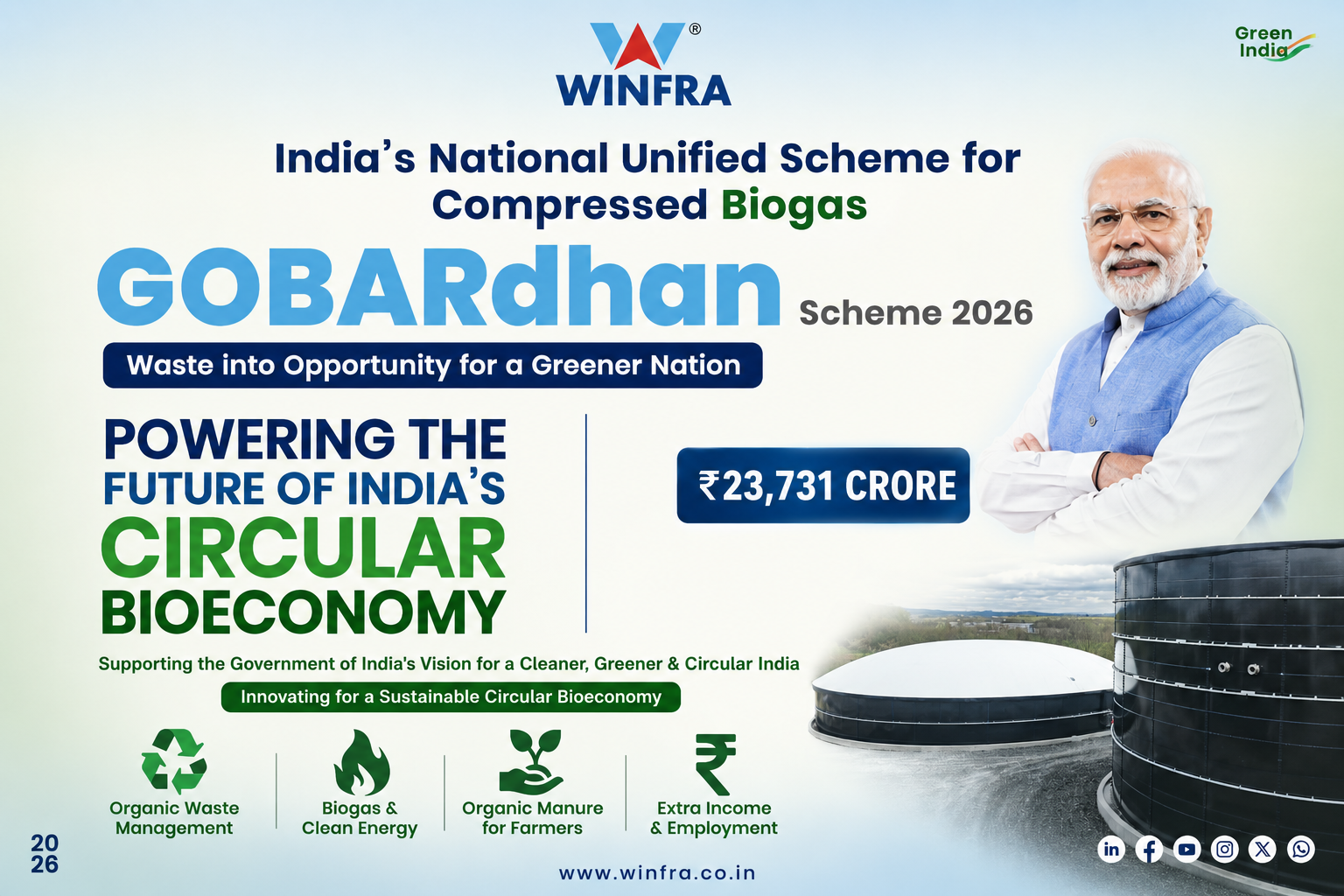
Recognizing this opportunity, the Union Cabinet has approved the GOBARdhan National Circular Bioenergy Scheme with a financial outlay of ₹23,731 crore for the period FY 2026-27 to FY 2035-36. The scheme aims to transform India’s waste management ecosystem by significantly increasing domestic Compressed Biogas (CBG) production while creating a circular economy that converts waste into clean fuel and organic fertilizer.
The initiative is expected to accelerate investments in bioenergy infrastructure, create employment in rural areas, improve farmers’ income, reduce dependence on imported fossil fuels, and strengthen India’s commitment toward sustainable development and Net Zero goals.
For industries, municipalities, EPC contractors, dairy farms, sugar mills, food processing companies, and renewable energy developers, the policy opens unprecedented opportunities. It also creates a growing demand for reliable storage infrastructure such as Glass-Fused-to-Steel (GFS) Tanks, Biodigester Reactors, process water tanks, slurry tanks, digestate storage systems, and wastewater treatment solutions.
This comprehensive guide explains everything you need to know about the new GOBARdhan policy and how modern storage infrastructure from Winfra Buildtech Pvt. Ltd., Faridabad, Haryana supports India’s bioenergy revolution.
What is the GOBARdhan National Circular Bioenergy Scheme?
GOBARdhan (Galvanizing Organic Bio-Agro Resources Dhan) is India’s flagship national circular bioenergy programme designed to convert biodegradable waste into valuable resources such as Compressed Biogas (CBG) and Fermented Organic Manure (FOM).
The newly approved unified scheme consolidates policy support for the bioenergy sector and provides long-term visibility to investors, technology providers, EPC companies, and infrastructure manufacturers.
Unlike earlier initiatives that primarily focused on encouraging CBG production, the new scheme builds an integrated ecosystem through financial incentives, institutional support, infrastructure development, pricing mechanisms, and technology innovation.
The Government envisions the programme as a catalyst for reducing waste, generating renewable energy, strengthening rural livelihoods, and supporting India’s energy transition over the next decade.
Why Was This Policy Introduced?
India produces enormous quantities of biodegradable waste every year. Agricultural residue, livestock waste, municipal organic waste, and industrial biodegradable waste represent a largely untapped energy resource.
Historically, much of this waste has been burned or disposed of in landfills, contributing to severe environmental challenges, including air pollution and methane emissions. At the same time, India continues to rely on imported natural gas to meet a significant portion of its energy demand.
The GOBARdhan Scheme seeks to address these interconnected challenges by:
- Promoting scientific waste management.
- Increasing domestic production of renewable Compressed Biogas.
- Supporting cleaner transportation fuels.
- Creating additional income streams for farmers through biomass sales.
- Generating high-quality organic manure.
- Encouraging rural entrepreneurship and MSME participation.
- Strengthening India’s energy security.
- Advancing the country’s circular economy objectives.
The policy represents a shift from treating waste as a liability to recognizing it as a strategic economic resource capable of delivering environmental, agricultural, and industrial benefits.
Key Highlights of the ₹23,731 Crore GOBARdhan Scheme
The scheme introduces several important policy measures designed to accelerate CBG adoption across India:
- Long-term implementation from FY 2026-27 to FY 2035-36.
- Stable administered pricing framework for CBG.
- Capital assistance of up to ₹2 crore per Ton Per Day (TPD) of installed capacity.
- Institutional credit guarantees for eligible developers.
- Support for pipeline connectivity with City Gas Distribution (CGD) networks.
- Dedicated ecosystem funding for biomass mapping, technology innovation, and organic manure processing.
- Promotion of circular bioeconomy through integrated waste utilization.
These initiatives are expected to improve project viability, attract private investment, and support the large-scale deployment of CBG plants across urban and rural India.
How a Compressed Biogas (CBG) Plant Works
A modern CBG plant follows a structured biological process to convert biodegradable waste into clean fuel.
The typical workflow includes:
- Collection of cattle dung, crop residue, food waste, and organic biomass.
- Feedstock preparation and homogenization.
- Anaerobic digestion inside specially engineered biodigester reactors.
- Production of raw biogas containing methane and carbon dioxide.
- Biogas purification and upgrading.
- Compression into Compressed Biogas (CBG).
- Injection into the gas distribution network or use as transportation fuel.
- Processing of digestate into Fermented Organic Manure (FOM).
Each stage requires dependable storage systems capable of handling aggressive organic media under demanding operating conditions.
This is where modular steel storage technologies play a critical role.
Why Storage Infrastructure is Critical for Every CBG Plant
While policy discussions often focus on subsidies and gas production, the success of every bioenergy project ultimately depends on the reliability of its storage and processing infrastructure.
A typical CBG facility requires:
- Biodigester Reactors
- Glass-Fused-to-Steel (GFS) Digester Tanks
- Feedstock Mixing Tanks
- Slurry Storage Tanks
- Digestate Storage Tanks
- Process Water Tanks
- Equalization Tanks
- Leachate Collection Tanks
- Fire Water Storage Tanks
- Fermented Organic Manure (FOM) Storage Tanks
- Wastewater Treatment Tanks
Selecting durable, corrosion-resistant storage systems helps reduce lifecycle costs, improve operational reliability, and minimize maintenance over decades of continuous operation.
How Winfra Buildtech Supports India’s Bioenergy Mission
Headquartered in Faridabad, Haryana, Winfra Buildtech Pvt. Ltd. manufactures modular storage solutions that support the rapidly expanding renewable energy, wastewater treatment, and industrial infrastructure sectors.
As India’s demand for Compressed Biogas projects increases under the GOBARdhan Scheme, Winfra supplies engineered storage systems designed for long service life, operational efficiency, and rapid installation.
Winfra’s Core Product Portfolio
- Glass-Fused-to-Steel (GFS) Tanks
- Biodigester Reactors & Tanks
- Fusion Bonded Epoxy (FBE) Tanks
- Zincalume Water Storage Tanks
- Process Water Tanks
- Fire Water Storage Tanks
- Industrial Water Storage Tanks
- STP & ETP Tanks
- Leachate Tanks
- Slurry Storage Tanks
These modular systems are suitable for municipalities, industries, dairy plants, distilleries, food processing facilities, ethanol plants, sugar mills, commercial developments, and bioenergy projects across India.
Why Winfra GFS Tanks are Ideal for CBG Projects
Glass-Fused-to-Steel tanks combine the structural strength of engineered steel with a glass coating fused at high temperature, creating an exceptionally durable and corrosion-resistant storage solution.
Advantages of Winfra GFS Tanks
- Superior corrosion resistance
- Excellent chemical resistance
- Modular bolted construction
- Faster installation than conventional RCC tanks
- Minimal maintenance
- Long service life
- Easy expansion for future capacity
- Leak-resistant design
- Factory-controlled manufacturing quality
- Lower lifecycle cost
- Suitable for anaerobic digestion, wastewater, slurry, digestate, and industrial process water
These benefits make GFS technology one of the preferred storage solutions for modern CBG infrastructure.
Winfra Biodigester Reactors
The biodigester reactor is the heart of every biogas plant.
Winfra designs biodigester systems capable of supporting efficient anaerobic digestion across a wide range of organic feedstocks, including cattle dung, agricultural residue, press mud, municipal organic waste, food waste, dairy waste, and industrial biodegradable waste.
Key Benefits
- Optimized methane production
- Reliable biological performance
- Reduced operating costs
- Modular scalability
- Durable construction
- Long operational life
- Compatibility with automated plant systems
- Support for sustainable waste management
By integrating advanced biodigester technology with modular storage systems, Winfra helps project developers build reliable and future-ready bioenergy facilities.
Conclusion
The GOBARdhan National Circular Bioenergy Scheme is more than a financial incentive programme—it is a long-term strategy to transform India’s renewable energy, waste management, and rural economy.
As thousands of new CBG plants are expected to be developed over the next decade, dependable infrastructure will become essential for ensuring safe, efficient, and sustainable operations.
With expertise in Glass-Fused-to-Steel (GFS) Tanks, Biodigester Reactors, Fusion Bonded Epoxy Tanks, and modular industrial storage solutions, Winfra Buildtech Pvt. Ltd., Faridabad, Haryana, is well positioned to support industries, municipalities, EPC contractors, and renewable energy developers across India.
By combining engineering excellence with durable storage technologies, Winfra contributes to the successful implementation of India’s circular bioeconomy and clean energy vision.